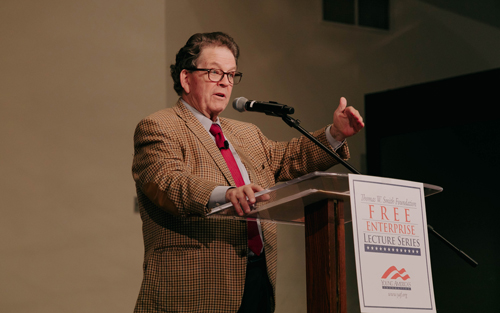
Distinguished economist Dr. Art B. Laffer connected past and present, explaining his case that lower taxes lead to greater prosperity for all.
He spoke to more than 300 business students, faculty and community members Tuesday evening in the DeSantis Family Chapel. Young America鈥檚 Foundation sponsored Laffer鈥檚 talk, made possible by a charitable gift from the Thomas W. Smith Foundation. Laffer met with Rinker College of Business students earlier in the day.
Laffer鈥檚 economic acumen and influence in triggering a worldwide tax-cutting movement in the 1980s have earned him the distinction in many publications as 鈥淭he Father of Supply-Side Economics.鈥� Laffer was a member of President Ronald Reagan鈥檚 Economic Policy Advisory Board for both terms, a member of the Executive Committee of the Reagan/Bush Finance Committee in 1984 and a founding member of the Reagan Executive Advisory Committee for the presidential race of 1980. He also advised Prime Minister Margaret Thatcher on fiscal policy in the United Kingdom during the 1980s.
High taxes lead to economic collapse, a rise in unemployment and lower quality of life for the poor, Laffer said. The rich earn less and shelter what they do earn, so that, 鈥淲henever they raise taxes on the rich, the rich pay less in taxes.鈥�
State-level data offer supporting evidence that higher taxes don鈥檛 lead to better results, Laffer said. Eleven states have adopted income tax since the 1960s, and those states are also the ones with the slowest-growing population, he said. Lawmakers who set tax rates reason that they need the money to provide public services, such as roads, police and schools. But according to external measures only two states saw slight improvements to education, Laffer said, while the others saw a decline.
鈥淭hey didn鈥檛 even get the public services they had suffered so long for,鈥� Laffer said.
Today, the U.S. is in the midst of a spending crisis, with the debt-to-gross domestic product ratio rising dramatically and a huge transfer of wealth to people who are paid not to work, Laffer said. He asked the audience to imagine if the government gave a billion dollars to every person.
鈥淲hat do you think would happen if the government actually did this? Why work?鈥�
In this scenario, the diminished number of people in the labor force would cause production to decline, he said. As the demand for goods increases, so would the volume imports and consumer prices. Cargo ships would back up at ports, unable to unload.
鈥淭his is exactly what is happening,鈥� Laffer said.
By taking from someone who has more and giving it to someone who has less, 鈥淵ou reduce that person鈥檚 incentive to produce,鈥� Laffer said. 鈥淚t鈥檚 math.鈥�
The economist also drew on history to make his case for lower taxes. In the 1920 presidential election, which followed World War I, Warren G. Harding ran on a promise to cut tax rates for a 鈥渞eturn to normalcy,鈥� while his opponent, Ohio Governor James M. Cox pledged to keep tax rates high to pay off debt. Harding crushed Cox.
Harding slowly lowered tax rates, and 鈥渢he U.S. economy boomed like you鈥檇 never seen before,鈥� Laffer said. The Roaring Twenties followed.
When Herbert Hoover took office in 1929, Congress passed the Smoot-Hawley Act, which imposed heavy tariffs on imported goods to encourage U.S. industry and protect American labor. Instead, the stock market crashed, unemployment soared and there was a run on banks, Laffer said. Instead of backing off, Hoover decided more taxes were the answer.
鈥淭here wasn鈥檛 a tax they didn鈥檛 find to raise,鈥� Laffer said.
When John F. Kennedy succeeded President Dwight D. Eisenhower, the U.S. was lagging behind Russia, Laffer said, but Kennedy cut tax rates, grew the economy and improved defense, sparking 鈥渢he go-go 60s.鈥� The four presidential administrations that followed were 鈥渢ragically-flawed,鈥� Laffer asserted.
But every time Laffer was depressed about the state of affairs, there was something 鈥渞eally wonderful鈥� ahead, he said.
Said Laffer: 鈥淭axes have consequences and so do elections.鈥�


