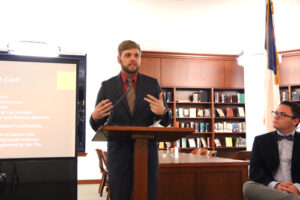
 As a聽LeMieux Fellow, Aaron Buch 鈥�19 wrestled with the tough questions posed by gene editing, and Nate Esbenshade 鈥�19 analyzed potential consequences of the聽.
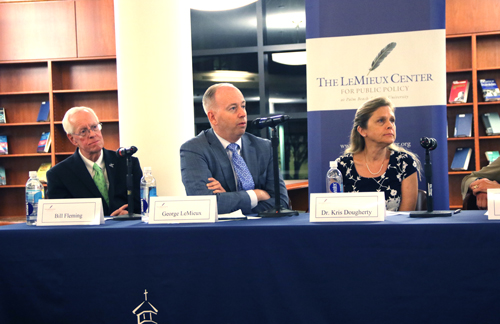
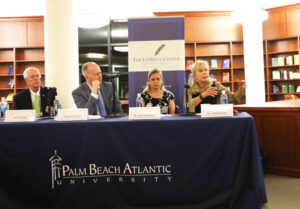
The fellows presented their undergraduate research findings before a panel of former U.S. Sen. George LeMieux, President William M. B. Fleming, Jr. and faculty advisers Drs.聽Kris Dougherty聽and聽Linda Raeder. Their presentations at the start of 海角在线鈥檚聽Family Weekend聽attracted a large audience of former classmates.
Buch, a medicinal and biological chemistry major from Milwaukee, Wisconsin, began with a reference to the 1997 sci-fi film聽聽based at a time in the future where parents can have designer babies.
鈥淭hat future is not as far off as you think,鈥� Buch said, citing the case of a Chinese scientist who genetically edited two baby girls to give them HIV immunity.
Genetic editing can be used to improve livestock and agriculture, restore extinct and remove invasive species and cure otherwise incurable genetic disorders such as sickle cell anemia and cystic fibrosis, Buch said.
There are two types of genetic editing, Buch said. With somatic cell editing, the edits die with the individual. With germline editing, the edited genes get passed on from parent to child. Scientists and ethicists haven鈥檛 fully grappled with ethical questions about intentionally altering the genes of a living organism, he said.
 For example, is it affordable for everyone? Does it create more unity or division? What does it do to the parent-child relationship? As Christians, do we have a moral responsibility to end human suffering?
Gene editing presents a social justice issue, because not everyone can afford it. For example, the treatment for a particular blinding eye disease is $500,000 per eye.
鈥淲e have discrimination down to a science,鈥� he said, quoting the 鈥淕attaca鈥� movie.
At its worst, genetic editing hearkens back to the eugenics movement of the 1920s, 30s and 40s, Buch said.
Allowing germline editing would fundamentally alter the parent-child relationship, exacerbating helicopter parenting to a new level, Buch said. Parents would want to get the greatest return on their investment.
Finally, while gene editing should be used to alleviate suffering, it would be an overstep to cure certain diseases, Buch said. People with diabetes, Down syndrome and autism can still live fulfilling lives, Buch said, noting that his sister has Type 1 diabetes.
鈥淎ll life does matter,鈥� Buch said.
The U.S. government does not fund germline research, a position in line with 83 percent of Americans who believe editing a baby鈥檚 genes to increase intelligence is wrong, Buch said.
鈥淭his is an issue of what it truly means to be human,鈥� Buch said. 鈥淭hat鈥檚 why we need more input. We need more people engaged in this discussion.鈥�
Buch concluded that somatic cell editing is acceptable for the treatment of medical conditions, but allowing germline editing would open a Pandora鈥檚 box.
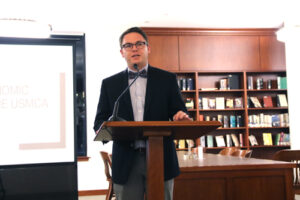 Esbenshade鈥檚 research examined the consequences of the United States-Mexico-Canada Agreement (USMCA), a renegotiation of the North American Free Trade Agreement (NAFTA).
Although NAFTA did increase trade with Mexico and 11 additional Central and South American countries, it did not curtail illegal immigration from Mexico as intended, Esbenshade said. Modest benefits of the agreement are difficult to tie directly to NAFTA because there were so many technological advancements in the 1990s. America lost jobs but gained economic growth in the form of efficiency and lower prices for consumers.
Currently, Mexico has a competitive advantage in the labor market, said Esbenshade, a politics major from Elizabethtown, Pennsylvania.
Renegotiating NAFTA was one of President Donald Trump鈥檚 main talking points on the campaign trail. Esbenshade said he doubts the president will get enough聽聽to make the USMCA a reality, because elected officials from the opposing party don鈥檛 want to hand him a political win.
A renegotiated agreement would have the most significant effects on the agricultural and auto industry. It would open Canada鈥檚 dairy market for American farmers and automotive manufacturers that assemble their cars in Mexico to use more U.S.-made parts to avoid tariffs. A significant portion of those cars must be made by Mexican workers earning a minimum wage of $16 per hour 鈥斅�, Esbenshade said.
Of course, the agreement could incentivize car manufacturers to automate production or cause them to move jobs to Honduras to save on labor costs, Esbenshade said.
鈥淐orporations find a way to make a profit,鈥� Esbenshade said.
 Further, the USMCA makes stricter intellectual property rights laws benefitting the U.S., Esbenshade said. In his analysis, he questioned whether the policy is free trade or protectionist and arrived at the conclusion that it is both. The idea of protecting 鈥淴 industry against Y country鈥� appeals to organized groups who can lobby their legislators, he said.
Esbenshade concluded, reluctantly, that it should be passed. However, with ongoing impeachment inquiries and a lack of support from Democrats, that seems unlikely, he said. A vote would need to occur in early 2020.
鈥淚n an ideal world, there would be no need for free trade agreements. Everyone would trade freely with each other,鈥� Esbenshade said. 鈥淲e don鈥檛 live in an ideal world.鈥�
LeMieux said it鈥檚 a joy to work with two excellent Palm Beach Atlantic students on a research project each year, and this year鈥檚 class was no exception.
鈥淚 could not be more proud of the work that Aaron and Nate did,鈥� LeMieux said. 鈥淚 look forward to seeing their success in the future.鈥�
Buch is a science teacher at Shoreland Lutheran High School in Wisconsin, and Esbenshade is a public policy intern at the Commonwealth Foundation for Public Policy Alternatives.
Photo 1:聽LeMieux Center for Public Policy Fellow Aaron Buch ’19 presents his research about genetic editing in the Lassiter Rotunda of the Warren Library on Thursday, Oct. 3, 2019.
Photo 2:聽Former U.S. Sen. George LeMieux, center, poses a question to LeMieux Center for Public Policy Fellow Aaron Buch after Buch’s presentation on genetic editing. President William M. B. Fleming, Jr. and Buch’s faculty adviser Dr. Kris Dougherty are on either side of LeMieux.
Photo 3:聽LeMieux Center for Public Policy Fellow Nate Esbenshade ’19 presents his research on the United States-Mexico-Canada Agreement in the Lassiter Rotunda of the Warren Library on Thursday, Oct. 3, 2019.
Photo 4: Dr. Linda Raeder, Nate Esbenshade’s faculty adviser, asks a question after his presentation on the United States-Mexico-Canada Agreement. Also on the panel are President William M. B. Fleming, Jr. (left), former Sen. George LeMieux, and Dr. Kris Dougherty.


