Imagine a paraplegic using a mind-controlled suit to walk again. Or a frazzled employee with a brain implant that automatically dims the lights in his office when he鈥檚 feeling stressed. Or a driver spared from causing a deadly accident because his brain implant disables his company car when he鈥檚 too drowsy to drive.
Now imagine you鈥檝e got one of those little computer chips in your brain, only instead of it being used for good, big companies like Amazon use it to convince you to buy something you don鈥檛 need without you ever realizing that you鈥檝e been manipulated.
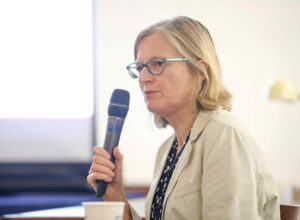
World-renowned ethicists and theologians critiqued these scenarios Thursday during the Jess Moody Faith & Culture Forum. Speakers included , chair in moral and practical theology at the University of Aberdeen (Scotland); , director of the Laudato Si鈥� Research Institute at Campion Hall, University of Oxford; and , Jerre and Mary Joy Stead professor of Christian social ethics at Garrett-Evangelical Theological Seminary at Northwestern University. Such moral questions are also explored in 海角在线鈥檚 philosophy, technology and ethics course in the program.
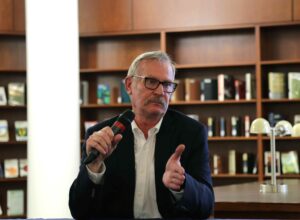
The forum included multiple sessions throughout the day, drawing about 300 people.
Brock opened the forum by contrasting the transhumanist hope of fixing human bodies and defying biological death with the Christian hope of embracing one鈥檚 body and eventual death that leads to resurrection life. Brock drew from the example of a French man, known only as Thibault, paralyzed in all four limbs for four years who stood up and walked in a mind-controlled exoskeleton suit in a lab in France.
The expensive research resulted in Thibault鈥檚 limbs mimicking walking movements as though he was wearing a spacesuit.
鈥淭hibault may have had a fun adventure in science, but it is unlikely to make any significant difference in his mobility in the years to come,鈥� Brock said.
Humans already rely on a near-constant connection to the internet and smartphones, Brock observed, making the question not whether, but when, neurotransmitters will be embedded into healthy brains. This 鈥渟urveillance capitalism鈥� will give big tech companies like Facebook, Amazon and Google access to a 鈥済old mine鈥� of information to predict what consumers will do next, Brock said.
New technologies have applications for treating Parkinson鈥檚 disease, alleviating chronic pain and monitoring mental health. But Brock expressed worry about the increasingly common sentiment that institutions should invest in creating a statistically 鈥渘ormal鈥� human rather than outfit communal space for people with disabilities.
Virtual and extended realities also have therapeutic uses for treating psychiatric disorders. However, these powerful tools are vulnerable to exploitation by bad actors because they are unregulated, Deane-Drummond said.
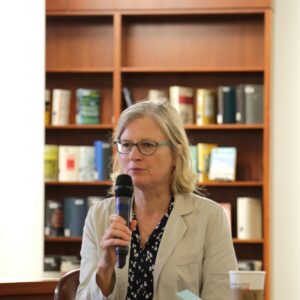
Her research examines transhumanism from a scientific perspective. Transhumanists believe the mind is equivalent to the person and that people should upload their brains onto a computer chip and insert it into prosthetics, Deane-Drummond said.
But transhumanist beliefs are inconsistent with current neuroscience, she said.
鈥淲hat we do with our minds affects our bodies, and what we do with our bodies affects our minds,鈥� she said.
Transhumanism offers 鈥渕oral enhancements鈥� such as controlling rage or making people less racist that may seem appealing, Deane-Drummond said. However, such 鈥渆nhancements鈥� are inherently immoral because they robotize humans at the cost of their freedom, she said.
Waters added that pharmaceuticals already control behavior quite a bit. While medication may improve quality of life, creative genius in artists and writers is often is destroyed, he said.
Churches and businesses are using virtual reality to create religious experiences that don鈥檛 necessarily align with the Christian understanding of a relationship with God, Deane-Drummond said.
Virtual reality can supplement the work of the church but it cannot replace it, Waters said.
鈥淭here鈥檚 something about physical proximity that is important to Christianity.鈥�


