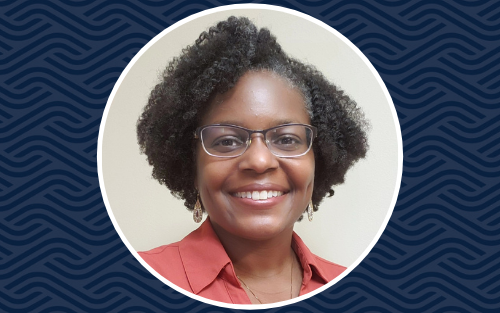
Inspired by personal experience, is on a mission to empower people with chronic illnesses to live the lives they want.
A year and a half ago, Hardy was diagnosed with , a disease in which the body鈥檚 immune system attacks part of the nervous system, which can affect the way the brain communicates to the rest of the body. Symptoms include tingling, weakness, difficulty walking and temporary loss of vision. They vary from person-to-person, depending on which part of the body the disease is attacking.
Prior to her diagnosis, Hardy struggled to walk from the parking lot to her office, and cross-campus treks to the Fraser Dining Hall were out of the question. Now that her condition is managed by medication and lifestyle changes, Hardy is hardly affected, she said.
Hardy, interim dean of the , has chronicled her experiences with frank, engaging entries on her blog . The blog鈥檚 title plays on the pharmacist being the patient and the importance of being 鈥減atient鈥� with oneself when navigating the diagnosis.
Dealing with the disease has helped Hardy learn to manage stress and has impacted her relationship with God.
鈥淭his diagnosis has helped me be more candid with God, and He has been more candid with me,鈥� Hardy said. 鈥淭here are still going to be things that are outside of your control.鈥�
When Hardy looked for support groups and Facebook communities for people with MS, she longed for something different.
鈥淚 didn鈥檛 want to have a mindset of sadness or that I was no longer of value,鈥� Hardy said. 鈥淭he blog brings a different light to a disease that can be pretty scary. It gives an alternative to how you can manage it.鈥�
On the blog, Hardy tackles topics such as medication management, diet, rest, the healthcare team and lifestyle changes. She wants the material to be accessible to anyone, regardless of the ability to pay. Eventually, she plans to publish her knowledge in a workbook that a patient with any chronic illness can use.
Hardy has about healthcare disparities and culturally-competent healthcare, subjects that she teaches to pharmacy students at 海角在线. She said practitioners at the hospital treated her differently when she began to speak in medical terms.
鈥淭here was a different approach because of the person I looked like,鈥� said Hardy, who is Black. 鈥淚 tell the healthcare providers up front that I鈥檓 a pharmacist, and I use the medical language.鈥�
Hardy鈥檚 passion is advocating for patients who don鈥檛 have someone to help them navigate the healthcare system. She entered the pharmacy profession to prevent maltreatment such as the , she said.
鈥淚 need to be that person out in the community,鈥� Hardy said. 鈥淲ith the blog, I鈥檓 still that person.鈥�
provided a lighthearted look at how difficult it was for Hardy to alter her cherished pizza nights to comply with the directions on her medication.
talked about Hardy鈥檚 determination to continue dancing, a creative pursuit that she鈥檚 had since she was 5 or 6 years old. Lately, Hardy enjoys salsa dancing and Bomba, an Afro-Puerto Rican dance that originated from enslaved people who worked in the sugar cane fields in Puerto Rico.
Shortly after the diagnosis, Hardy鈥檚 physical therapist said she would not release Hardy from her care until Hardy went dancing. Hardy happily obliged. She credits dancing with helping her regain her ability to walk.
鈥淒ance has always been my stress reliever,鈥� Hardy said. 鈥淚t鈥檚 also a community that I鈥檝e been able to connect with wherever I go.鈥�
The experience offers an important lesson for Hardy鈥檚 students. She wants them to remember that each patient is still a person with his or her own personalities, hobbies and dreams.
And she鈥檚 adopted a new motto that encourages her to think about what she鈥檚 able to do in the present, rather than what she may not be able to do in the future.
鈥淢y motto is, 鈥榃ell, you can do it today.鈥� That鈥檚 a message that I hope other people can see in their lives.鈥�


