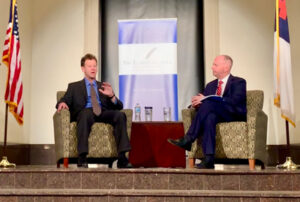
 Visiting The LeMieux Center for Public Policy, foreign policy expert and scholar聽聽outlined strategies for the United States to mitigate danger posed by its three great rivals 鈥� Russia, North Korea and China.
O鈥橦anlon, a senior fellow at the聽, specializes in American national security policy and defense strategy. He also serves as a director of research for the Brookings foreign policy program. He teaches at the Columbia, Princeton and Syracuse universities and at the University of Denver. In 2015, Brookings published the most recent of O鈥橦anlon鈥檚 books,聽The Future of Land Warfare.
O鈥橦anlon visited 海角在线 on Wednesday (2/6) to deliver the keynote address, titled聽Geopolitics in the Next Decade, in the LeMieux Center鈥檚 speaker series. Sen. George LeMieux reminded the audience that each forum is designed to model 鈥渁 way to discuss issues of the day that is considerate to people of all views and focus on the issues that really matter.鈥�
O鈥橦anlon began his talk by offering an optimistic look at the state of the world. 鈥淎nybody who鈥檚 watching the newspapers, anybody鈥檚 who鈥檚 watching those of us in the Capitol, anyone who鈥檚 looking for problems to be solved, is probably a bit frustrated right now,鈥� he said. 鈥淚 want to underscore just how much we have going for us, even as we see a country divided and a world that鈥檚 challenged by multiple hotspots.鈥�
As evidence, he said that for the first time in human history, half the world鈥檚 population has achieved middle-class status or greater. 鈥淭hat鈥檚 an incredible accomplishment, and it鈥檚 primarily on account of American foreign policy.鈥� And while the world has seen challenges to democracy in Russia, Turkey, the Philippines and elsewhere, more people than ever are living in democracies, or at least in countries that are partially free.
Most significantly, he said, 鈥淭he major powers are still not fighting each other. If we think about the state of the world today, we don鈥檛 see anything akin to what produced the world wars.鈥�
O鈥橦anlon went on the outline the major sticking points in America鈥檚 most challenging international relationships, beginning with Russia.
There, he said, President Vladimir Putin 鈥渓oves to play global Risk. He鈥檚 pretty good at it, but in places that are of secondary strategic importance to the United States. It鈥檚 not that we want to see Syrians or Ukrainians suffer. But when we disagree, it does not mean that we are on the verge of World War III.鈥�
O鈥橦anlon does maintain that the United States needs to shore up democratic election processes in Eastern Europe and prevent any foreign election tampering here at home. But he makes a strong argument against trying to counter Putin by expanding the number of nations in the North Atlantic Treaty Organization, particularly in the case of Ukraine and Georgia. He believes further expansion of NATO would dilute the effectiveness of the alliance and would be inappropriate for nations that are Russia鈥檚 immediate neighbors.
Shifting his focus to East Asia, O鈥橦anlon believes President Donald J. Trump has created an opportunity to ratchet back the serious global threat posed by North Korea, though he said the president鈥檚 grandstanding has gone too far. 鈥淕iven his personality and his vanity, [Trump] wants to say he鈥檚 eliminated the North Korean threat, which is false,鈥� said O鈥橦anlon, a Democrat who admitted that he is not a Trump fan. In the true spirit of a LeMieux Center dialogue, though, O鈥橦anlon applauded Trump for refusing any concessions until North Korea makes real progress on nuclear disarmament.
O鈥橦anlon said he doesn鈥檛 believe complete demilitarization of North Korea is likely, as leader Kim Jong Un considers weaponry to be 鈥渢he crown jewels of the country.鈥� He sees a greater possibility for success if Trump were to approach Kim by saying, 鈥� 鈥榁erifiably dismantle all of your capabilities to produce more weapons and thereby cap your nuclear arsenal, and I will tolerate you keeping some of your warheads for the foreseeable future. We鈥檙e not going to give up all the sanctions, but we can talk about humanitarian aid and trade sanctions.鈥� I think that鈥檚 a deal that North Korea might take.鈥�
Finally, O鈥橦anlon asked, 鈥淗ow do you handle a rising power like China?鈥� In addition to its rapid economic growth and its place as the second-biggest military spender on the planet, he said, China is showing no signs of further democratization. 鈥淭hat doesn鈥檛 mean China has to be our enemy. We have to compete hard in a number of domains.鈥�
He pointed to low-level incursions by China鈥檚 military as a form of muscle-flexing. 鈥淥ur job is to push back without escalating,鈥� he said. 鈥淚鈥檓 worried about a scenario where China might seize an island and we have to ask, as Americans, 鈥榃hat do we do?鈥� We have to have a resolute, tough response with economic sanctions and perhaps increased military presence, but not a full-out military response to take back islands nobody cares about, where nobody lives. I do think we have to think hard about China, about which kinds of scenarios we鈥檇 be willing to risk world war and which scenarios we might need to push back in a more subtle way. We have to be careful about asking the American people to support big wars over nothing.鈥�
In the question-and-answer period that followed, O鈥橦anlon addressed the United States鈥� involvement in conflict areas around the world, especially in Syria and in Afghanistan. Not long ago, he returned to Afghanistan on a research trip to see if he could continue to make a case for U.S. troops to remain.
鈥淭he Afghan people defeated the Soviet Union in the Cold War, and we pulled the plug on them and allowed the Taliban to take over,鈥� he explained. 鈥淏ut you know what? Today, the Afghan government controls most of the major cities and we鈥檙e down to 14,000 troops. I鈥檝e looked at this from a thousand different angles. I鈥檓 done with talking about exit strategies. If we leave precipitously, we don鈥檛 know what鈥檒l happen, but more likely the Taliban is going to win. I consider 14,000 troops to be an acceptable level of U.S. presence, because I can鈥檛 see a better option.鈥�
Syria, O鈥橦anlon said, is even more difficult and complex. He鈥檚 seeing indications that Trump may be willing to step back from insisting on a full and immediate withdrawal of American troops from Syria. 鈥淭hat may be the better part of wisdom,鈥� O鈥橦anlon said, 鈥渢o say we want to get out, but to recognize that doing it on any kind of schedule is really hard.鈥�
During the introductions, Rep. Tom Rooney was introduced as the newest LeMieux Center senior fellow. The next event in the LeMieux Center speaker series event will be Feb. 27 at 6 p.m. in the DeSantis Family Chapel, when the keynote address will be delivered by Judge Jeanine Pirro, host of聽.


